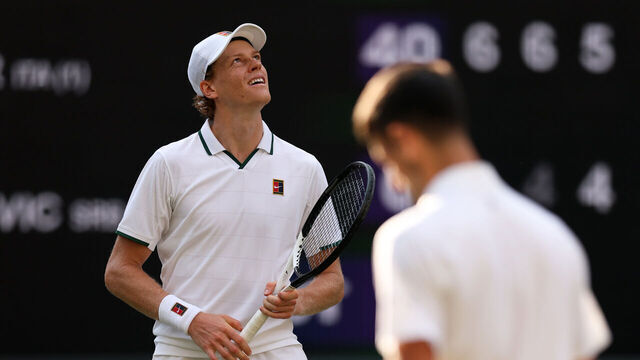
LONDON (AP) — Jannik Sinner was still struggling to rediscover his rhythm a month after his meltdown at the French Open and Novak Djokovic was lurking in the Wimbledon semifinals.
Sure, Sinner had won his opening five matches of his title defense at the All England Club. But none of those performances resembled the way that Sinner awed the tennis world earlier this year during a 30-match winning streak.
So how did the top-ranked Sinner suddenly rediscover the form that enabled him to completely overwhelm Djokovic — the seven-time Wimbledon champion — during Friday’s highly awaited encounter on Centre Court?
The answer lies in a return to familiar gound.
Instead of continuing to toil away on Wimbledon’s grass courts, Sinner spent Wednesday practicing on an indoor hard court, the top-ranked player’s team said.
Hard courts are the surface where Sinner has won three of his four Grand Slam titles and the indoor setting was reminiscent of where Sinner learned to play while growing up in a small Alpine village in the Italian Dolomites.
The decision by his two coaches, Darren Cahill and Simone Vagnozzi, enabled Sinner to regain the timing that has made him the strongest and most feared baseline player in the sport.
“He’s reminded himself just how much that ball can explode off his racket,” said Andre Agassi, who was also coached by Cahill in his career.
Agassi noted how Sinner was “swinging with a full conviction” against Djokovic.
The improvement displayed against Djokovic was a stark contrast from Sinner’s opening five matches.
Sinner twice had to come back from a set down in a five-set marathon against Miomir Kecmanovic in his opener; he was pushed to two tiebreakers by 48th-ranked Nuno Borges in the second round; dropped his serve twice against Jenson Brooksky in the third round; had to play another tiebreaker against Japanese qualifier Shintaro Mochizuki in the round of 16; and was also tested by Jan-Lennard Struff in the quarterfinals.
Against Djokovic, Sinner led 40-26 in winners, committed only 15 unforced errors to Djokovic’s 23 and saved the only break point he faced with an ace.
“Was a good old blowout,” Djokovic acknowledged.
Agassi, who won Wimbledon in 1992, also preferred to play on hard courts and was also known for hugging the baseline and taking the ball early like Sinner.
“With the grass, especially if you’re going to live aggressively, you have to almost count on that bounce or you got to wait, take a beat, let it bounce, know where the ball’s going to be so you can hit that ball square,” Agassi said on the BBC
“What that does over time is it makes you hesitate a little bit, makes you forget the cleanness of your swing,” Agassi added, noting that he, too, would seek out hard courts during the grass season: “You just got to go clean that up and the best way to do it for me has always been getting onto the hard court, trusting the balance, reminding myself what conviction feels like when I hit the ball.”
Djokovic had beaten Sinner over five sets in their previous meeting in this year’s Australian Open semifinals. This time, Djokovic never really threatened and it was finished in three sets.
“He was just a level or more better than I was,” Djokovic said, adding that Sinner was the “much better player” and a “dominant force.”
Sinner hadn’t displayed that much confidence since the opening two sets and six games of the third set against Juan Manuel Cerundolo in the second-round of Roland Garros in late May — before he wilted in a Paris heat wave and was eliminated in stunning fashion.
Now, he’s favored to seal his second straight Wimbledon title against French Open champion Alexander Zverev in Sunday’s final.
Zverev is 'different player now'
Zverev, whose breakthrough at Roland Garros came in his fourth Grand Slam final, is attempting to become the first man in the professional era (since 1968) to win his second major title at the next event immediately after his first.
But Sinner has won nine straight meetings with Zverev and 14 consecutive sets against the German.
“You can’t underestimate anyone, especially in a Slam final,” Sinner said. “His victory at Roland Garros really helped him. He’s playing very aggressively. He’s a different player now.”
By reaching the final, Zverev will leapfrog the injured Carlos Alcaraz and move up to No. 2 when the new rankings are released on Monday.
Serving precision
Sinner served 16 aces and no double-faults against Djokovic and won 88% of the points when he got his first serve in.
“You cannot attack his first serve. You can try to read it, chip it, block it, get it back in play,” said Djokovic, one of the game’s top returners. “Very unpredictable serve, great variety, great balance, great pop. He’s using his height extremely well.”
Djokovic also had high praise for Sinner’s second serve, noting how he places it “very deep in the box” with “a lot of rotation."
“He can go for speed. He doesn’t make many double-faults. He’s just super solid,” Djokovic added.
The 6-foot-3 (1.91-meter) Sinner is the tournament leader with 113 aces while Zverev is fifth with 87. But the 6-foot-6 (1.98-meter) Zverev has put 74% of his first serves in play compared to 66% for Sinner.
Another aspect of their success rate is remarkably close: Sinner has held in 96 of his 102 service games and Zverev has held in 97 of 102.
“The serve-return patterns," Zverev said, “are going to be very, very important.”
___
AP tennis: https://apnews.com/hub/tennis