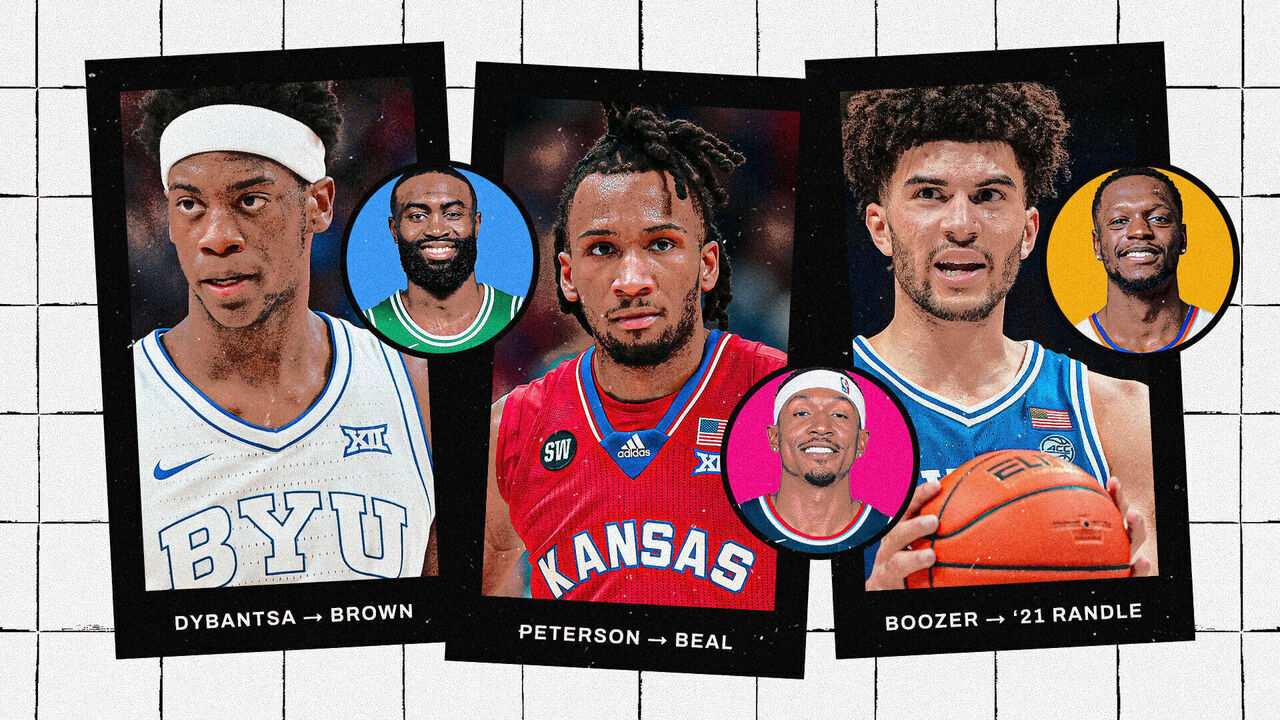
Predicting how players in the 2026 NBA Draft will turn out is an imperfect science, but identifying a player's archetype and their potential impact in the Association is useful.
Some of the top prospects have a higher ceiling and volatile floor, while others are considered slightly safer picks. Using other current and former NBA players as comparables is a good way to conceptualize that gap.
With that in mind, here are the best-case and worst-case scenarios for each of the draft's top 10 prospects.
Height: 6-foot-9
Weight: 210 lbs
Wingspan: 7-foot
Max vertical: 42 inches
Best-case comparison
Jaylen Brown: The five-time All-Star finished sixth in MVP voting and fourth in the NBA in scoring last season with his teammate Jayson Tatum sidelined for much of the campaign. That's the type of scoring upside Dybantsa has. He led college basketball in points per game at 25.5, flashing elite athletic ability for someone with his length, fluidity, and on-ball skills. Like Brown, Dybantsa profiles as a potential leading scorer on a championship contender - so long as he has the right pieces around him and his 3-point jumper continues to progress.
Worst-case comparison
Jonathan Kuminga: If Dybantsa's 3-pointer and overall shot selection don't improve in the spaced-out NBA with more talent around him, he'll run the risk of becoming an "eye test All-Star" like Kuminga. Kuminga has shown tantalizing flashes and, like Dybantsa, he can do things with the ball in his hands that most players with his size and athleticism simply cannot.
But Kuminga's lack of 3-point shooting, passing, and defense make it very hard to put him on the court as a complementary piece to other stars, and he isn't quite good enough to be the lead option. If Dybantsa doesn't manage to develop a more well-rounded skill set like Brown, his lack of spacing, passing, and defense could put him in the same predicament as Kuminga.
Height: 6-foot-6
Weight: 195 lbs
Wingspan: 6-foot-10
Max vertical: 37.5 inches
Best-case comparison
Bradley Beal: It's easy to forget that prime Beal averaged over 30 points in two straight seasons for the Washington Wizards as a 6-foot-4 elite shooter with evolving on-ball pop as a facilitator. Peterson didn't showcase tons of on-ball ability in his heavily scrutinized year at Kansas, but he has a pedigree from his prep days as a strong passer. He proved that his jumper and scoring ability are more than theoretical, topping 20 points in 12 of his 24 college games. Like Beal, Peterson's jumper-heavy offensive game profiles at its peak as a second option on a playoff team, or a high-usage star on an average NBA squad.
Worst-case comparison
J.R. Smith: If Peterson's playmaking never comes around at the pro level, he could wind up as more of a spark plug with a strong 3-point shot and good wing length and athleticism. Smith shot over 37% from deep across his 16-year NBA career but only averaged 2.1 assists per game. As a result, his shot-happy 2-guard archetype was best served by a bench role, and he won Sixth Man of the Year with the New York Knicks in 2013. Peterson's scoring is pretty much inevitable, but adding other elements to his game will unlock his upside.
Height: 6-foot-9
Weight: 250 lbs
Wingspan: 7-foot-1
Max vertical: 35 inches
Best-case comparison
2021 Julius Randle: Pardon the specificity, but there simply aren't many players quite like Boozer, which is both good and bad. He's got a bizarre combination of genuine on-ball ability, playmaking, and jump-shooting skill in a 4-man's frame, plus elite strength and downhill power, but without top-tier athleticism. Randle's best season by far was his 2020-21 campaign with the Knicks. He finished eighth in MVP voting after averaging 24.1 points, 10.2 rebounds, 6.0 assists and 2.3 3-pointers per game while shooting 41.1% from deep. At his peak, Boozer's well-rounded game in a body that's too bulky to play the 3 and too small to play the 5 matches up perfectly with Randle's one marvelous campaign.
Worst-case comparison
Jabari Parker: Parker is one of the greatest tweeners the sport has ever seen. A top high school prospect and the No. 2 pick in the 2014 draft (sandwiched between Andrew Wiggins and Joel Embiid), Parker had a bulky 6-foot-9 frame like Boozer and was coming off a spectacular campaign at Duke. The more recent Blue Devil is a bit bigger and stronger than Parker, but both are somewhat short and rely more on physicality than burst to get their buckets. Parker's 3-pointer stagnated and his playmaking never improved - but worst of all, he never had a true position to guard defensively. It would be surprising to see Boozer's development halt in the same manner, but if he struggles at the next level, it'll likely be for similar reasons to Parker.
Height: 6-foot-10
Weight: 215 lbs
Wingspan: 7-foot
Max vertical: 39.5 inches
Best-case comparison
Bam Adebayo: Boasting length, strength, and top-tier athleticism as slightly shorter 5s, Wilson and Adebayo were both top three in college basketball in dunks per game during their lone seasons at blue-blood schools. It took Adebayo a couple of years to smooth out his game, but he eventually became a perennial All-Defensive team member and a capable playmaker, as well as an occasional 3-point shooter. Wilson has shown elite defensive flashes and the odd dribble move with great footwork, but his jumper is still multiple years away. If he can develop in a similar fashion, he too can become a multi-time All-Star given his fluidity, bounce, and frame.
Worst-case comparison
Moussa Diabate: If Wilson's playmaking and shooting don't progress as expected, he's unlikely to reach superstar status. But with his defensive tools, terrific athleticism, and strong rebounding motor, he could still carve out a valuable role like Diabate has for the Charlotte Hornets. Unlike some other prospects who may have real cause for concern at the next level if things don't go according to plan, Wilson's natural athletic abilities should get him a spot in some NBA rotation no matter what happens with his skill development.
Height: 6-foot-3
Weight: 185 lbs
Wingspan: 6-foot-6
Max vertical: 36.5 inches
Best-case comparison
Damian Lillard: Acuff's freshman numbers are nearly identical to Lillard's junior season stats at Weber State, which is almost unbelievable given Lillard was three years older and Acuff did it in the top-tier SEC. Exceptionally few players possess Acuff's kind of on-ball skill. He can put the ball in the hoop from all three levels and can fully take over a game as a scorer and a passer. He may not quite measure up to a younger Lillard athletically, but Acuff uses his touch in the lane to remain efficient inside the arc. His prep shooting numbers aren't quite as good as his year at Arkansas, however, so he would need to stay consistent as a 37% shooter from range.
Worst-case comparison
Darius Garland: Garland is obviously still good, and he's made two All-Star teams, but there's a reason the Cleveland Cavaliers shipped him away to take a chance on an aging James Harden. One of the smaller point guards in the league, Garland lacks elite athletic ability, and analytics have rated him as a negative defender in every season of his career. Acuff's defensive tape in college is incredibly poor, and he doesn't have the athletic tools to suggest that will change. Like Garland, Acuff could prove capable of scoring 20 points and dishing out eight assists per game in the NBA, but he might not make a significant overall impact because of his defensive shortcomings.
Height: 6-foot-5
Weight: 190 lbs
Wingspan: 6-foot-6
Max vertical: 36 inches
Best-case comparison
2026 Ty Jerome: Wagler may not be as athletic as the other guards at the top of this class, but he has a terrific jumper off the catch and the dribble, plus real playmaking chops and a 6-foot-5 frame that will allow him to play the 1 and the 2 at the next level. Jerome took a few years to find his footing but averaged 20 points per game in his 15 contests with the Memphis Grizzlies last season. Not flashy, but a really productive offensive player.
Worst-case comparison
Jordan Clarkson: Another guard with good length who came into the NBA as a 1-2 hybrid, Clarkson's playmaking never fully materialized, and he became more of a microwave scorer off the bench. He's still been a more than serviceable scoring option with an occasional pop of playmaking, but he was never enough of a pass-first player to be a true starting point guard in the NBA. Wagler's in danger of the same outcome - he lacked high school pedigree before playing for a well-oiled Illinois offense.
Height: 6-foot-3
Weight: 190 lbs
Wingspan: 6-foot-8
Max vertical: 39.5 inches
Best-case comparison
Peak D'Angelo Russell: Brown makes his presence known as a tough shotmaker and flashy yet effective passer with a sizable frame. There's no denying he's a point guard, but his efficiency, shot selection, and athletic burst can be questionable. When Russell was at his peak, it didn't matter if he took the occasional bad shot or made a tough pass; he was so skilled that he remained a very effective on-ball option. Brown is equally gifted and can make eye-popping plays when he's in rhythm.
Worst-case comparison
Lonzo Ball: Ball and Brown were both great passers in college, but their shot diets are very three-heavy, and their scoring efficiency remains a concern despite positive defensive and playmaking. Ball's never shot more than 42% from the field in an NBA season because he struggles to get downhill and never developed the ability to create in the middle of the floor. Brown shot 41% from the field at Louisville with a similar profile. If he doesn't refine his shot selection, he could be dealt a similar fate despite his strengths.
Height: 6-foot-3
Weight: 190 lbs
Wingspan: 6-foot-4
Max vertical: 40.5 inches
Best-case comparison
De'Aaron Fox: Speedy and ultra-shifty with the ball in his hands, Flemings' greatest asset is the ability to get to his spots and finish in the lane while keeping the ball on a string. Flemings and Fox were both seen as plus defenders with good anticipation coming into the draft. Flemings has a head start on Fox in terms of his 3-point jumper, but Fox is slightly longer. Flemings also hit a handful of clutch shots this past season for Houston, something that became Fox's signature during his time with the Sacramento Kings.
Worst-case comparison
TyTy Washington: Flemings is the smallest of the top point guards in the class with a 6-foot-4 inch wingspan. Some pundits also suggest his 39% shooting from deep in college is an aberration considering he attempted so few long-range shots and didn't have a reputation as an elite shooter prior to college. Washington shot 35% from deep in college with strong passing and defensive metrics, but he has yet to find his jumper and was simply too small for the NBA. In a group of Flemings, Wagler, Acuff, and Brown, Flemings seems to have the lowest floor.
Height: 6-foot-10
Weight: 210 lbs
Wingspan: 6-foot-11
Max vertical: 37 inches
Best-case comparison
Brandon Ingram: Not many guys around Ament's size have the fluidity and scoring touch to stick on the wing. Ament and Ingram share a gigantic 9-foot-2 standing reach, allowing them to shoot over defenders even with a contest. When it comes to Ingram's signature shot, Ament was solid, making 40% of his 97 dribble mid-range pull-up attempts last year. If Ament can refine his offensive game, he has All-Star potential.
Worst-case comparison
Nikola Jovic: Ament's potential remains very much hypothetical because he was so inefficient as a scorer at Tennessee and didn't fully showcase his playmaking or defensive upside. Jovic is another jumbo wing who came into the league with significant scoring potential. However, he's been very inefficient as a shooter and just bottomed out with a 36.6% mark from the field in his fourth NBA season. Right now, Ament is the worst player that will be drafted this high, and it's far from guaranteed that he'll figure it out.
Height: 7-foot-3
Weight: 260 lbs
Wingspan: 7-foot-6
Max vertical: 28 inches
Best-case comparison
Arvydas Sabonis: Only 29 players standing 7-foot-3 or taller have played in the NBA, so there aren't many potential physical comparisons for Mara. Victor Wembanyama, Ralph Sampson, and Sabonis are the only three from that group to average more than two assists per game across their NBA careers, and Mara surpassed that number during his tremendous junior season at Michigan. Like Sabonis, he largely isn't a shooter, and he's capable defensively. With Mara's distinctive skill set, he might not look like anyone else who's currently in the NBA.
Worst-case comparison
Zydrunas Ilgauskas: Ilgauskas was a solid member of some excellent LeBron James-led teams in the mid 2000s. He provided the same defense and rebounding as Sabonis without the same passing skill. If Mara's offensive game doesn't translate from college as well as expected, he could be more of a role player like Ilgauskas versus a star like Sabonis.
Matthew Winick is a college basketball analyst and consultant. You can find his work on X at @matthewwinick.