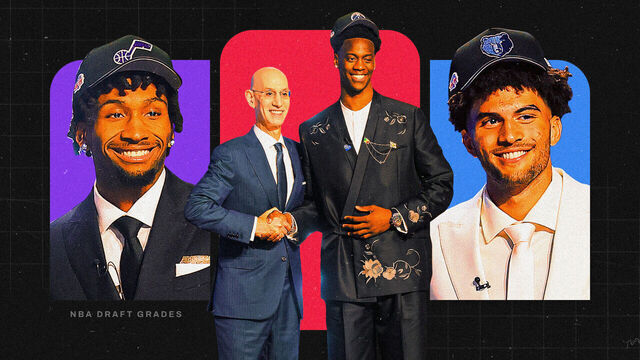
With Round 1 of the 2026 NBA Draft complete, theScore contributor Matthew Winick hands out initial grades for each team's incoming rookies.
👉 Jump to:
ATL | BKN | BOS | CHA | CHI | CLE | DAL | DEN | DET | GSW | HOU | IND | LAC | LAL | MEM | MIA | MIL | MIN | NOP | NYK | OKC | ORL | PHI | PHX | POR | SAC | SAS | TOR | UTA | WAS
Atlanta Hawks
Grade: A
After point guards Keaton Wagler, Mikel Brown Jr., and Darius Acuff Jr. were selected from picks Nos. 5 and 8, it was a near foregone conclusion that Flemings would get taken by the Hawks. Of the four, he could end up being the best. With a burst off the dribble that looks like a prime De'Aaron Fox or Derrick Rose, Flemings looks the most athletic of the quartet. As a shooter, he's also further along than both at this stage. His biggest flaw is a short 6-foot-4 wingspan, but he'll now play alongside tons of length at every other position. Flemings to Atlanta is the perfect blend of a talented player in a perfect situation to succeed.
The Hawks capped off their Tuesday by adding a polished, physical big man in Ejiofor, who will provide toughness down low while developing passing and shooting skills. He fits as a backup big man and can play right away.
Brooklyn Nets
Grade: C+
Brown looks like a prototypical point guard with ideal length and a modern shot diet. That said, he's balancing his strengths with concerns about injuries and efficiency issues in college at Louisville. Brown has an affinity for attempting challenging passes and contested, deep jumpers. He can make the extraordinary, flashy plays, but on a Nets team without a clear nucleus right now, it remains to be seen whether he can be properly reined in. Still, Brown profiles as Brooklyn's clear point guard of the future.
The Nets went a safer route with their second pick, adding the draft's best passing big man in Jefferson. While there's a bit of overlap in his game with last year's late-first-rounder, Danny Wolf, Jefferson has a higher defensive floor.
Boston Celtics
Grade: C
The Celtics finished last in rim rate last year, and Cenac's biggest flaw is his lack of physicality as a big man. Despite his great length and defensive upside, he lacks the strength and handle needed to get to the rim. Though Cenac will be a solid roller in pick-and-roll sets, he won't be a clear upgrade over Boston's other bigs.
Charlotte Hornets
Grade: A
The Hornets put a clear emphasis on specialists as they round out a roster loaded with young stars. Steinbach is the draft's best rebounder, and Anderson is arguably the best overall shooter. Neither will become a franchise cornerstone, but their ability to play a valuable role alongside the pieces already in place is a very mature and well-intentioned approach from a Hornets team that has been picking in the lottery for what seems like its entire existence.
Chicago Bulls
Grade: A
Wilson spent much of this draft process in a tier of his own - not quite on the level of the top three but the clear best prospect available beyond that. With absurd bounce and burst at 6-foot-9, he's arguably the draft's most athletic player, and he's an underrated passer with outstanding defensive upside. Wilson's 3-point jumper is relatively nonexistent right now, but he'll become a fully well-rounded player if he can get it to fall as he develops.
The Bulls then doubled down on athleticism with Swain, one of the best downhill drivers in the class. Chicago ranked 27th in the NBA in rim efficiency last season, but they'll surely improve in that area with Wilson and Swain in the fold. Having enough shooting around those two and Josh Giddey will be the key to success.
Cleveland Cavaliers
Grade: N/A
Dallas Mavericks
Grade: B+
It's very telling that new Mavericks head coach Dusty May had the choice of all three potential lottery selections that he coached at Michigan, and he chose Johnson - arguably the lowest-ranked prospect of the three. Though Johnson was the least productive in college, his tremendous athletic tools, multi-positional defensive versatility, and blossoming jumper give him the highest NBA upside. May saw Johnson firsthand and clearly believes that his defensive ability and emerging 3-point shot can complement franchise cornerstone Cooper Flagg.
The Mavericks ended the night with a gamble on Spanish wing De Larrea, who's still completing his season across the pond.
Denver Nuggets
Grade: N/A
Detroit Pistons
Grade: B
The Pistons enjoy a unique luxury with their star point guard, Cade Cunningham, standing at 6-foot-6. His height allows them the flexibility to pair a smaller guard alongside him. Okorie is just 6-foot-1 but is a blur going downhill, with elite ball-handling and scoring. His presence will alleviate a ton of offensive pressure off Cunningham and give the Pistons a jolt of speed and shotmaking. Trading three second-round picks to move up four spots and take him at No. 17 is a tad rich, but it speaks to how highly the organization valued him.
Golden State Warriors
Grade: B
There's no greater sign that the Warriors are prepared for one last dance with Stephen Curry, Draymond Green, and Steve Kerr than the selection of Lendeborg. The oldest pick of the first round, the 23-year-old doesn't have a supremely high ceiling. However, he could have arguably been playing NBA rotation minutes last year instead of his spot on the title-winning Michigan squad. Lendeborg's all-around game in a terrific wing frame will be a great fit for next year's Golden State group, but he won't be a franchise superstar to build around once all the vets move on.
Houston Rockets
Grade: N/A
Indiana Pacers
Grade: N/A
Los Angeles Clippers
Grade: C
The Clippers are in a weird spot between competing and rebuilding. Wagler qualifies for both of those scenarios, but he may not thrive in either. He should be able to play right away alongside diminutive point guard Darius Garland because he has size and off-ball shooting, and he also has the chance to become a long-term on-ball option if the team builds around him.
But there were other point guards on the board with higher upside, and other candidates in this range possess the physical build to make a major impact from Day 1. Wagler doesn't have the athletic toolkit of many top point guards in 2026, and he may fall flat at the intersection of being immediately ready to contribute and having upside down the road.
Los Angeles Lakers
Grade: B-
There's no questioning Carr's scoring ability or his ridiculous length and athleticism at the off-ball guard spot. But there are questions about his processing, passing, motor, and ability to contribute. For a Lakers team dead set on winning now, the uncertainty of Carr's ability to help in that goal is a bit concerning. Still, for a late first-rounder, Carr has immense talent.
Memphis Grizzlies
Grade: A+
The good thing about picking third in a draft with three elite prospects is that you can't look back and think you made the wrong choice. Boozer has been the best player at every level he's been at, including an incredible college campaign at Duke, where he won every player of the year award. He's the epitome of a blue-chip prospect.
The only thing holding Boozer back from being the top pick was questions about his athleticism and being an average-sized forward at 6-foot-8. However, his physicality and well-rounded game, with dribbling, passing, and shooting in his tool kit, give him the draft class' most complete repertoire. As Memphis dives into a rebuild, he's a clear superstar-level player who the team can build around and plan to complement with the right group of teammates.
The Grizzlies also added Lopez at No. 21, a decent gamble on a young project for a rebuilding squad. More importantly, they added five second-round picks to move down five spots in the draft to take him.
Miami Heat
Grade: N/A
Milwaukee Bucks
Grade: D+
On their first day of the post-Giannis Antetokounmpo era, the Bucks started with Arizona guard Burries, then added Ament with the selection reportedly acquired in the blockbuster trade. Burries is a score-first guard in an undersized 6-foot-4 frame, and Ament is an oversized 6-foot-10 wing who was very inefficient as a scorer at Tennessee. Both have theoretical upside, but neither has clear superstar potential or plays a premium position. Milwaukee had the chance to start its new age with a bang, but it came away with an underwhelming haul for a squad with two lottery picks in a loaded draft.
Minnesota Timberwolves
Grade: N/A
New Orleans Pelicans
Grade: N/A
New York Knicks
Grade: N/A
Oklahoma City Thunder
Grade: C
Every lottery pick the already-loaded Thunder get is just icing on the cake and a testament to the planning of team executive Sam Presti. But with an extremely expensive roster, OKC needs its rookie-scale players to be impact pieces since the organization's ability to sign free agents is very limited. The 7-foot-3 Mara will be a valuable defender off the bat, but his offensive game - built off passing and rim scoring - may take some time to get up to speed. That move feels like an overreaction to the Thunder getting eliminated in the postseason by another giant 7-footer in Wembanyama.
They teh Thunder traded up one slot to take Stirtz, a polished offensive guard who doesn't have a terrific frame or athletic chops. His ability to stay on the floor defensively in a playoff series is a big question mark, especially early. It feels unfair to grade Oklahoma City's draft based on playoff potential, but that's where we're at with the regular-season dominance of this franchise.
Orlando Magic
Grade: N/A
Philadelphia 76ers
Grade: B
Picking in the 20s isn't supposed to net you a star, but Philon's ability to make a giant impact on the 76ers is stunted by the fact that he plays the same position as star Tyrese Maxey. Additionally, playing those two together alongside VJ Edgecombe would give Philadelphia one of the smaller frontcourts in the league. What saves this pick is Philon's status as the clear best player available when he was selected at No. 22.
Phoenix Suns
Grade: B
The Suns traded into the first round and ended Peat's slide with Tuesday's final pick. Peat's smaller 6-foot-7 frame and broken jump shot were the main reasons for his slide, but he's an excellent athlete with great strength, bounce, and fluidity. If he can ever find a way to get the jumper to fall, he'll be a steal at this spot.
Portland Trail Blazers
Grade: N/A
Sacramento Kings
Grade: B+
No prospect in recent memory has as large a gap between ability on each end of the floor. Acuff is possibly the best offensive player of all 30 players selected Tuesday, but he's likely the single worst on defense. For a Sacramento team that's been stuck in a hard spot for much of the 21st century, taking a gamble on a pure point guard with utterly elite scoring and passing ability is worth the gamble, even if he's undersized and a sieve defensively. The question is whether he lands closer to an all-around star like Damian Lillard, an all-offense stat sheet stuffer like Trae Young, or a capable but unspectacular floor general like Darius Garland.
Nabbing Karaban at the end of the first round doesn't add much defense or athleticism, but it does give the franchise one of college basketball's all-time winners and a capable shooter on the wing. Isaiah Evans was probably a safer bet as a pure shooter on the board at No. 29, though.
San Antonio Spurs
Grade: A
Talk about an embarrassment of riches. The Spurs already have the Defensive Player of the Year in the frontcourt with Victor Wembanyama, and they added perhaps the draft's best defender in Quaintance, who put together a masterful defensive season two years ago at just 17 years old. Still recovering from a torn ACL, Quaintance can be eased back at his own pace on the loaded Spurs. While Quaintance's offensive game is largely just around the rim, Wembanyama's perimeter skill and growing passing chops could make things work on that end. Quaintance will start as a backup, but the duo will have a combined wingspan of 15-foot-5 when they end up playing together. Not long enough? The Spurs capped the night by adding physical big man Reed and his measly 7-foot-4 wingspan.
Toronto Raptors
Grade: C-
The Raptors' young core took a big leap last season, but they desperately needed another on-ball creator to pair with a team built on length, athleticism, and defense. Alabama point guard Philon was in the middle of a fall on the draft board, but Toronto chose to further add to its frontcourt with the Santa Clara super-sub Graves. Advanced analytics love Graves' well-rounded game, but the caveat is that those numbers came off the bench in a mid-major league. Though he has fine size, he isn't overly athletic. He shot 41% from deep, but it was on a limited 91-shot sample. Between questions about Graves' game and a scoring star remaining on the board, this feels like a missed opportunity.
Utah Jazz
Grade: A
The Jazz had two incredible options at No. 2 between Peterson and Boozer, who both would've gone first in many recent drafts. Boozer may have the higher floor, but it would be surprising to see the Jazz outright regret passing on a franchise legend's son to take Peterson.
Though Peterson was heavily scrutinized for how cramping issues during his one year at Kansas were handled, his on-court production was never questioned. He's a monster scorer with a jumper that's automatic off the catch and dribble, and he can create his own shot and finish at all three levels. The Jazz are already loaded in the frontcourt, and now they have a star at guard to pair alongside them. Any off-court issues that could derail this selection shouldn't be a big factor.
Washington Wizards
Grade: A
To kick off Tuesday's festivities, the Wizards did what was widely expected and took Dybantsa with the No. 1 pick. Dybantsa has the athletic profile of an NBA superstar with a tremendous blend of elite size, fluidity, and athleticism. His skill level is very high for a wing, but he could stand to improve his defense, 3-point shooting, and playmaking for others.
With the Wizards investing significantly in Trae Young at point guard, Dybantsa slots in well as a 1A option on the wing with the excellent defensive duo of Anthony Davis and Alex Sarr in the frontcourt. Washington will have loads of length to flank the smaller Young. The fit makes sense, the talent is there, and all signs point to the Wizards finally climbing back into relevance next season.
Matthew Winick is a college basketball analyst and consultant. You can find his work on X at @matthewwinick.