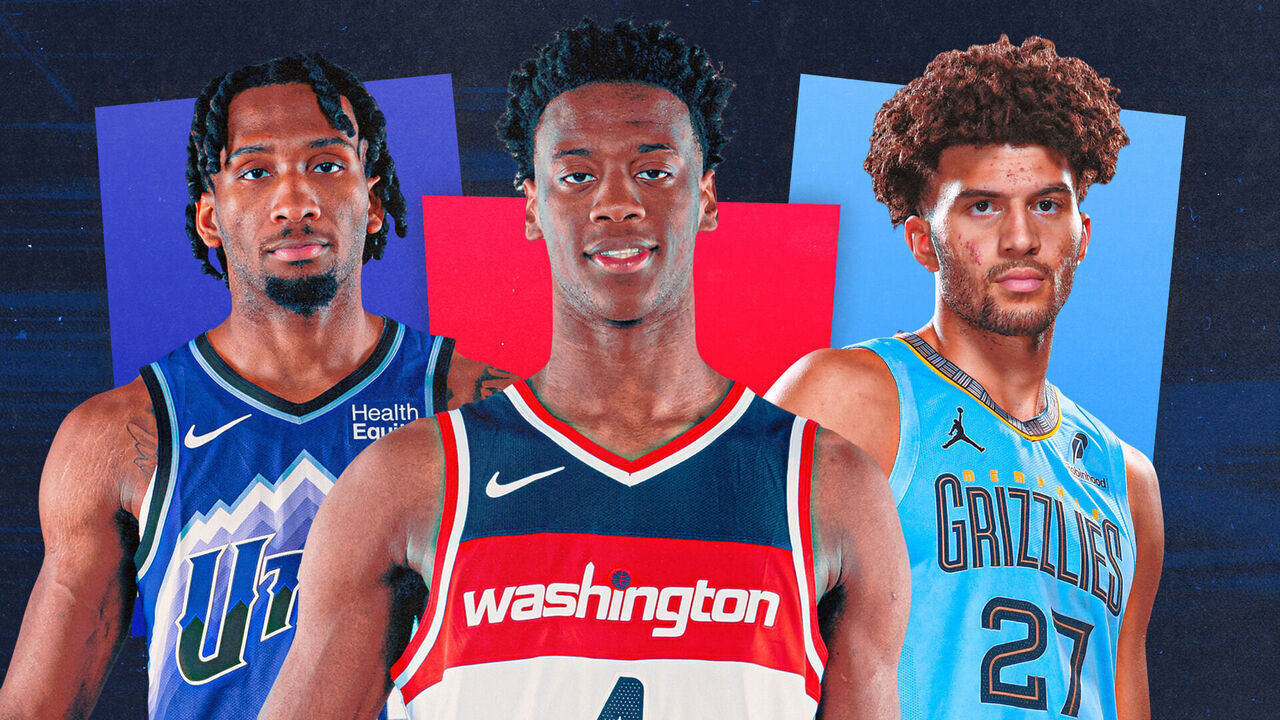
With the 2026-27 NBA campaign just a week away, here's a look at the top five candidates to win the league's Rookie of the Year award.
Acuff's got a clear path to significant playing time, and his development should be a priority with the Kings in rebuild mode. The ex-Arkansas floor general electrified college hoops last season with his scoring and playmaking, becoming the only player in the nation to average at least 20 points and six assists.
Acuff keeps opposing defenses off-balance with his ability to score at all three levels. The Bob Cousy Award winner controls the pace when driving to the basket, using a combination of hesitation moves, step-throughs, and brute strength to get to the rim. He finishes with either hand at point-blank range and through contact if needed.
Acuff's got a reliable floater and uses step-backs to create separation from defenders in the mid-range. The 6-foot-2 guard can also attack downhill off ball screens or pull up from distance if defenders go under them. He was superb in the open floor, he tossed lobs to his big men in pick-and-roll sequences, and he often hit cutters in stride to the basket.
The biggest concerns about Acuff's performance are on the defensive end: He tends to ball-watch and gets caught on screens, and he provides little resistance at the point of attack.
Rookie of the Year odds: +1500
The No. 1 recruit in last year's class, Dybantsa lived up to the billing during his lone season at BYU. The teenager paced the NCAA in scoring (25.5 points per game) and free-throw attempts (296) en route to earning consensus All-American first-team honors. He's got the skill set to carry that scoring prowess over to the NBA in Year 1.
Dybantsa's long strides and crafty footwork enable him to finish around defenders in the paint. His willingness to embrace contact on drives and smart use of pump fakes is often rewarded with free throws. The Cougars standout also knocked down 48.6% of his mid-range attempts last season, per Hoop Explorer. One of Dybantsa's go-to moves is a mid-post fadeaway, and he's a pull-up threat from the baseline or elbow. Dybantsa's offensive talents drew extra defenders, and he often made the right passing read out of double-teams.
Dybantsa's shown the ability to side-step into a three and drain catch-and-shoot triples. If Dybantsa develops into a consistent 3-point shooter, he'll have more chances to attack closeouts. The 6-foot-9 forward struggled with his shot selection in Summer League. Although nobody would be surprised if Dybantsa takes home Rookie of the Year, he may have fewer on-ball opportunities than some of his peers with Trae Young initiating the Wizards' offense and Anthony Davis needing touches as well.
Rookie of the Year odds: +425
Wilson could've been selected earlier in the draft if his lone season at North Carolina wasn't cut short by injury. The 6-foot-10 forward arguably authored the most impressive Summer League performance from this rookie class, averaging 23.5 points on 50% shooting - including a 41.9% clip from deep - to go along with 7.3 rebounds, 2.5 blocks, and 1.3 steals over four appearances.
Wilson was consistently a factor on both ends of the floor, showcasing his above-the-rim athleticism, backdoor cutting, shot-blocking, and downhill driving ability. The Georgia native's 215-pound frame helps him finish through contact when he gets into the teeth of the defense. After making only seven triples in college, Wilson had the confidence in Las Vegas to pull up, catch and shoot, and step back from beyond the arc. When Wilson turned over the ball, he immediately made amends by hustling back for chase-down swats.
Chicago's been starving for a star since the departures of Derrick Rose and Jimmy Butler. Wilson has the potential to fill that void and change the Bulls' fortunes.
Rookie of the Year odds: +325
Peterson's cramping issues overshadowed his freshman year at Kansas, but his talent is undeniable. The 6-foot-5 guard should slot in seamlessly alongside Keyonte George in the Jazz's backcourt. Peterson played off the ball at Kansas, using flare screens and pindowns to get clean looks from downtown. He does a good job of relocating to open spots beyond the arc when his teammates drive to the rim.
Peterson gets his share of buckets in the mid-range and at the rim, too. The No. 2 overall pick frequently uses step-backs to brush off defenders and shows a soft touch on floaters in the lane. He's explosive off the bounce and possesses the body control to finish above or around opposing players.
Utah's 29th-ranked defense should benefit from Peterson's presence as well. The Ohio native developed a knack for stealing the ball from big men once they turned their backs on him. Peterson's 6-foot-10 wingspan allows him to contest shots and get his hands in passing lanes.
Throughout the draft process, Peterson expressed his desire to play the point. While he's got plenty of work to do before the Jazz entrust him with that responsibility, he showed some potential in his drive-and-kicks and limited pick-and-roll playmaking reps with the Jayhawks. Peterson also averaged 7.4 assists per contest as a senior in high school.
Rookie of the Year odds: +350
Multiple players can make a strong Rookie of the Year case, but Boozer begins the 2026-27 campaign in prime position to capture the award. Memphis turned the page on Ja Morant this offseason and will likely lean on the Duke product to usher in a new era.
Boozer isn't the flashiest player, yet he consistently finds a way to stuff the box score. During his lone year with the Blue Devils, Boozer became the first freshman or sophomore to average at least 20 points, 10 rebounds, and four assists in one season since Larry Bird in 1976-77. He managed similar production in Summer League play, registering 18.5 points, eight boards, 3.7 assists, and 1.8 steals per contest during the Grizzlies' run to the championship game.
Boozer plays with physicality down low, using his 253-pound frame to back down defenders on the block, and he routinely crashes the offensive glass. He can get downhill to the rim off a high ball screen, he seals his man to provide avenues for post entry feeds, and he has the footwork to maneuver around taller foes. But Boozer's passing is what separates him from most players at his position. He can serve as a playmaking hub from the high post, make skip passes out of double teams, and spark the transition attack with hit-ahead passes.
Defensively, Boozer is agile enough to guard in space on the perimeter and can hold his own against stout big men. The reigning National Player of the Year is capable of hitting catch-and-shoot and off-the-dribble threes. Expect Memphis to give Boozer plenty of leeway this season as he irons out every aspect of his game.
Rookie of the Year odds: +310
US: Must be 21+. Gambling problem? Call 1-800-GAMBLER or 1-800-MY-RESET; Hope is here. Call (800)-327-5050 or visit gamblinghelplinema.org for 24/7 support (MA); Call 877-8-HOPENY or text HOPENY (467369) (NY).
CA: Please play responsibly. AB (18+) & ON (19+) only. If gambling is affecting your mental health or well-being, 211 Alberta is here to help. Call or text 211 or visit ab.211.ca (AB). Call ConnexOntario at 1-866-531-2600. Text us at 247247 or chat with us at www.connexontario.ca (ON).