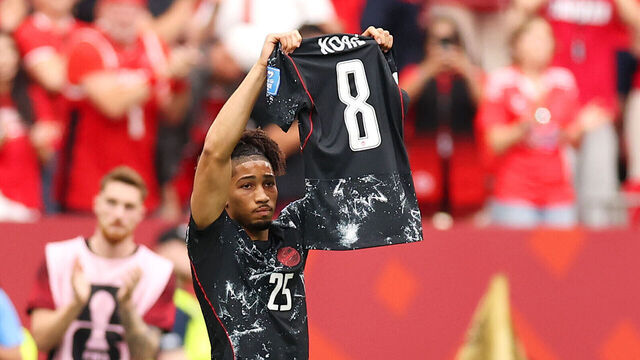
VANCOUVER, British Columbia (AP) — Canada’s first win at a World Cup came at a cost, and 22-year-old Nathan Saliba now might be the player asked to steady the midfield after his breakout performance in the 6-0 victory over Qatar.
Canada’s win was clouded by the gruesome injury to Ismaël Koné, who broke the tibia and fibula in his left leg after a challenge from Qatar’s Assim Madibo. Saliba replaced Koné and, less than 10 minutes later, he scored. He then held up Koné’s jersey in tribute.
“Saliba is a top player,” forward Liam Millar said before Canada’s training session Sunday. “He understands the game very well — he’s a very mature player, especially for his age.”
Canada coach Jesse Marsch has not said who will fill Koné’s role against higher-ranked Switzerland on Wednesday.
Bayern Munich star Alphonso Davies, who has not yet played in this World Cup due to a lingering hamstring injury, could also be in line to play against Switzerland. With a chance to top Group B and stay home in Vancouver for the Round of 32, Marsch could decide this is the moment for the star player’s long-awaited return.
Against Qatar, it was Saliba who delivered an immediate response to getting the call.
The Anderlecht midfielder curled a direct free kick from just outside the penalty area around Qatar’s wall and off the right post for Canada’s fourth goal of the game.
It was Saliba’s third international goal, his first at a World Cup and Canada’s first from a direct free kick at a World Cup.
Saliba’s tribute to Koné pointed to a close bond Canada’s squad has developed while dealing with multiple injuries that complicated its journey to this World Cup.
“When you have great brotherhood outside of the field,” Saliba said after the Qatar match, “it helps you make sacrifices on the pitch.”
Koné is the fourth Canada player in four years to face recovery for a broken leg. Goalkeeper Maxime Crépeau’s injury cost him a place at the last World Cup, and forward Tajon Buchanan had to recover from a broken leg in 2024.
Defender Moïse Bombito broke his leg in October. He saw his first 2026 World Cup action against Qatar and had been on the pitch for just five minutes when Koné, a close friend, was badly injured.
“I try to be there as much as I could for him and let him know that he’s not alone,” Bombito said at a Canada training session Monday.
Saliba, eager to be there for his team in Koné’s role, established himself as a trusted option against Qatar.
He has started only seven of his 16 appearances for Canada, compared with Koné’s 32 starts in 42 matches. Both players came through CF Montreal’s system, with Koné starring for the club in 2021 and 2022, and Saliba making his debut in 2023.
Saliba’s goal against Qatar was only part of what impressed his teammates. Midfielder Stephen Eustáquio said after the match that Saliba also provided “midfield presence,” helping Canada regain its footing after the emotional blow of losing Koné.
Saliba didn’t play in Canada’s opening 1-1 draw against Bosnia and Herzegovina, and Marsch acknowledged that he was often overlooked earlier because of the team’s depth in the midfield.
“I’m glad that (Saliba) trusted me,” Marsch said after his young midfielder’s performance against Qatar, “even though I let him down a bunch of times. I think the way that he’s played has shown that I made some mistakes along the way.”
Saliba, he added, has “a good eye for attacking plays, a good eye for passing final plays.”
___
AP World Cup: https://apnews.com/fifa-world-cup